
 Bianca Muller
If you have ever heard a strange, high-pitched call coming from the garden after dark, you may have had a dikkop nearby. And if you have ever looked across a lawn during the day and thought you spotted a strangely shaped stone with enormous yellow eyes, there is a good chance you have encountered one, too.
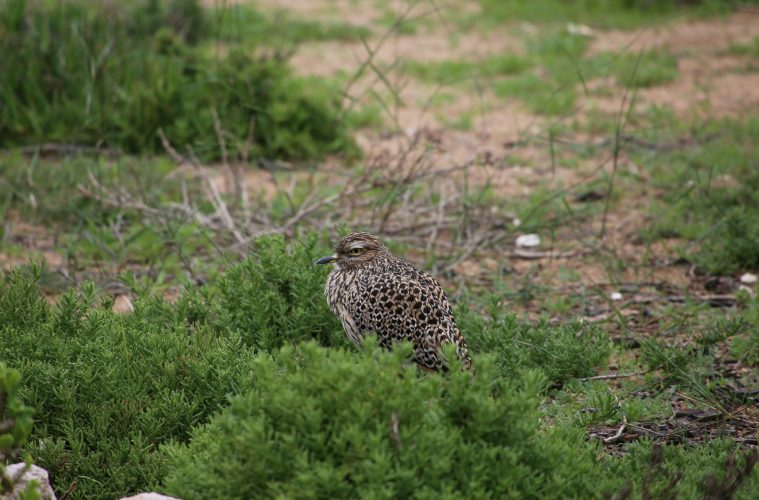
The spotted dikkop, also known as the spotted thick-knee or Cape thick-knee (Burhinus capensis), is a rather unusual South African garden visitor. It is a ground-dwelling bird with long legs, a chunky body, beautifully camouflaged spotted plumage and remarkably large yellow eyes. Despite its somewhat comical appearance, the dikkop is particularly well adapted to life after dark.
It is also a bird that has become surprisingly comfortable around people. Although its natural habitats include grasslands, savanna, semi-arid scrub and rocky areas, spotted dikkops are increasingly encountered in human-modified landscapes, including parks, playing fields, cemeteries, large lawns and urban areas.
What does a dikkop look like?
The dikkop is not difficult to identify once you know what you are looking for. Growing to around 40–45cm tall, it has a large, rounded head, prominent yellow eyes, long yellowish-green legs and a short, sturdy bill.
Its brown, cream and black-speckled plumage is particularly useful because it makes the bird remarkably difficult to spot when it is sitting motionless on bare ground or among grass and stones. During the day, a dikkop will often crouch or stand very still in the shade of a bush, tree or other cover rather than moving around in the open.
And then there are those knees. The name thick-knee refers to the noticeably enlarged joint on the bird’s legs. Despite the common Afrikaans name dikkop meaning “thick head”, its distinctive legs are actually responsible for the English name.
A bird that comes alive after dark
Dikkops are largely nocturnal and crepuscular, meaning they are most active at night and around dawn and dusk. This is one of the reasons they can be easy to miss despite being fairly common. Their huge eyes are perfectly suited to their after-dark lifestyle, helping them see while searching for food. They generally forage on the ground, running a few steps before stopping and quickly pecking at prey.
But it is their call that often gives them away. The dikkop has a loud, distinctive and somewhat eerie call that carries surprisingly far at night. It has been described as a shrill, piping or whistling sound that rises and falls in pitch. They are particularly vocal on moonlit nights, when they may call repeatedly while flying or moving around their territory.
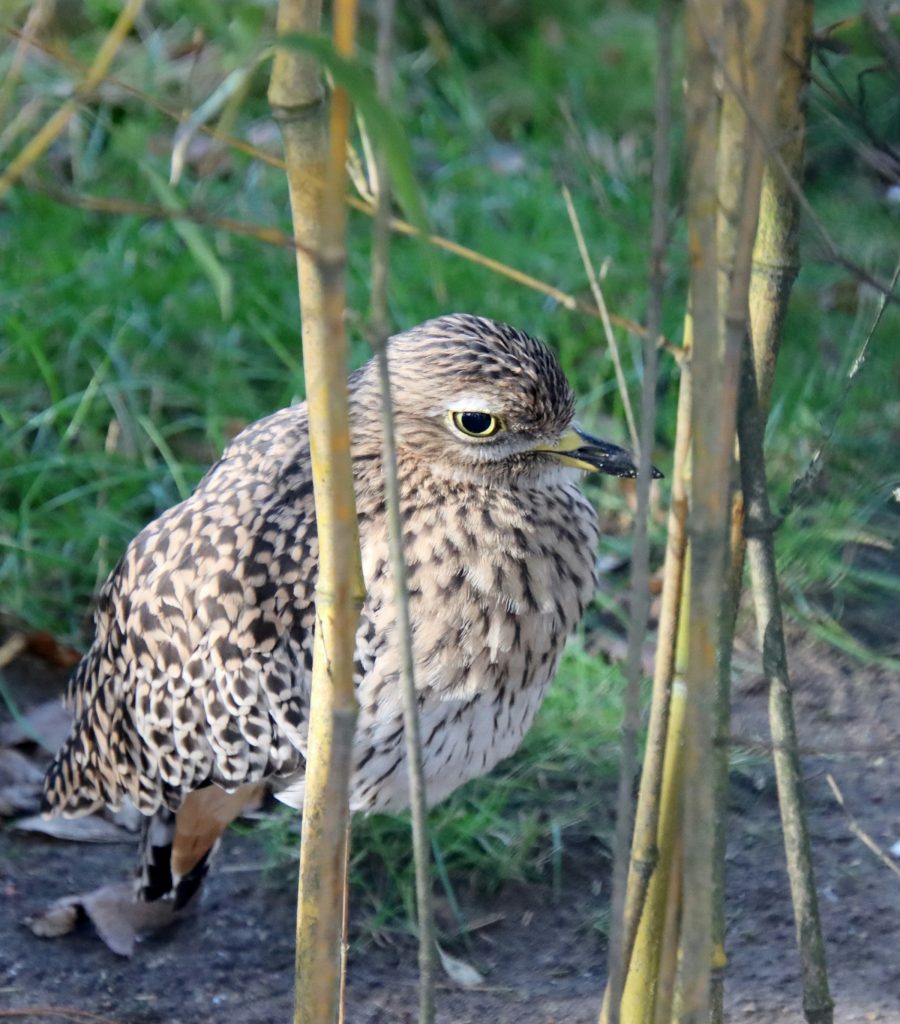
Photo: Unsplash
What do dikkops eat?
This is where the dikkop earns its place as a useful garden bird. Spotted dikkops are primarily insectivorous, although they are opportunistic feeders and have a varied diet. Their menu includes beetles, termites, grasshoppers, crickets, caterpillars, moths, bugs, ants and other insects. They will also eat spiders, worms, snails and other invertebrates. On occasion, they may take small lizards, frogs, rodents and even small snakes.
They are particularly fond of beetles and termites, making a dikkop wandering around your garden at night a rather useful pest-control assistant.
Unlike seed-eating garden birds that spend their time around bird feeders, dikkops prefer to forage across open ground. Their distinctive feeding technique involves running forward, stopping suddenly and then stabbing at prey with their bill. They also swallow grit, which helps with digestion.
Dikkops nest on the ground
One of the more fascinating things about the dikkop is that it does not build the sort of elaborate nest we might associate with garden birds. Instead, it lays its eggs in a shallow scrape on the ground, often with a few leaves, twigs, stones or other bits of material incorporated around or into the nest. The eggs are heavily camouflaged, helping them blend into their surroundings. Both parents take part in incubation and raising the young.
This ground-nesting lifestyle is one reason gardeners should take care when mowing large lawns or clearing areas of vegetation where dikkops are known to occur. Their camouflage is so effective that you may walk past a nest without realising it is there.
The adults also have a clever trick for protecting their chicks. When threatened, a parent may perform a distraction display, pretending to be injured in an attempt to lure a predator away from the young. Meanwhile, chicks can crouch down and remain completely still, relying on their camouflage to avoid detection.
ALSO SEE: Garden bird of the week: Pied barbet (Bonthoutkapper)
Feature image: Unsplash
