
 Bianca Muller
If you hear a loud, nasal “peh-peh” coming from a nearby tree, there’s a good chance a Pied barbet (Tricholaema leucomelas) is close by. Also known as the Acacia Pied barbet or Bonthoutkapper in Afrikaans, this bird is a familiar sight across much of South Africa, particularly in dry woodland, savanna and areas with scattered trees. It has also adapted surprisingly well to human-modified habitats, making gardens, parks and orchards part of its ever-expanding neighbourhood.
What does a Pied barbet look like?
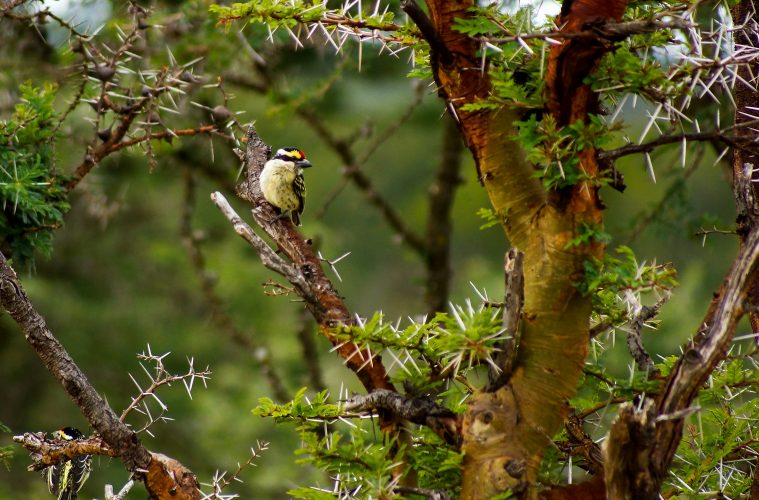
The Pied barbet is a small, chunky bird measuring around 15–18cm long, with a distinctive black-and-white head pattern that makes it relatively easy to identify. Look for a bright red forehead, black crown and a bold black stripe running through the eye, while the eyebrow is marked with white and yellow. Its throat and upper breast form a prominent black bib, contrasting with its pale underparts, while the back is mostly black with yellowish markings. The heavy black bill is another giveaway, with the bristles around its base giving barbets their characteristic appearance.
Juvenile birds are a little less striking than adults, as they lack the adults’ bright red forehead. If you’re trying to spot one in your garden, however, listening can be just as useful as looking. Their distinctive, nasal call is often what gives them away first.
Where can you find Pied barbets?
The Pied barbet is one of southern Africa’s more widespread barbets and occurs across virtually all of South Africa, extending into parts of southern Angola and south-western Zambia. It is particularly associated with semi-arid savanna, thornveld and mixed woodland, but it can also make use of wooded drainage lines, orchards, farmyards, parks and suburban gardens. Its ability to use trees outside its traditional habitat has helped the species expand its range considerably.
In the garden, look for Pied barbets around mature trees, fruiting plants and other areas offering food and potential nesting sites. They are generally seen alone or in pairs and are resident birds, although they may make local movements when food and water become scarce, particularly in drier areas.
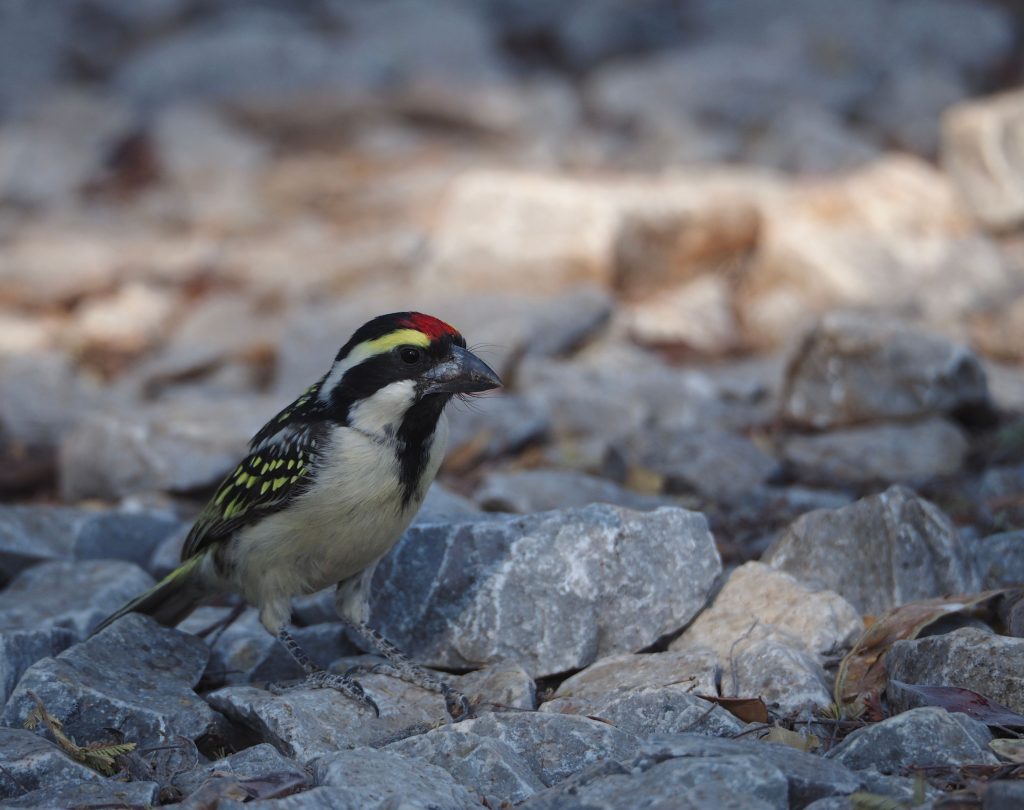
Photo: Pexels
What does the Pied barbet eat?
Fruit makes up an important part of the Pied barbet’s diet, but these birds aren’t strict vegetarians. They also feed on insects and other small food items and have been recorded eating nectar, flowers, petals and seed pods. Their diet can therefore vary depending on what is available in their surroundings.
Their feeding habits also make gardens with a variety of plants particularly useful. Instead of relying on a single food source, a garden that offers fruit, flowers and plenty of natural insect life can provide several options throughout the year. This is another reason to think twice before reaching for pesticides when you spot a few insects nibbling on your plants.
Why is it called the Bonthoutkapper?
The Afrikaans name Bonthoutkapper roughly translates to “variegated woodcutter”, which is a rather fitting description of this little bird’s habits. Like woodpeckers, Pied barbets use their powerful bills to excavate nesting cavities, although they aren’t woodpeckers themselves. They typically make their nests in soft or dead branches, usually between one and three metres above the ground.
The pair excavates a cavity with a relatively small, circular entrance, where the female lays a clutch of around two to four white eggs, with three being typical. Both parents take part in incubation, which lasts for up to about 18 days, and continue feeding the chicks after they hatch. Pied barbets can raise two broods in a breeding season.
So, next time you hear that unmistakable “peh-peh” from the garden, grab your binoculars and look up. That chunky little bird with the red forehead might just be your neighbourhood Bonthoutkapper.
ALSO SEE: Garden bird of the week: Cape robin-chat
Feature image: Unsplash
