
 Bianca Muller
Bees might get most of the credit, but they are far from the only creatures responsible for pollinating South Africa’s indigenous plants. Across the country’s fynbos, grasslands, forests and semi-arid landscapes, some rather unexpected animals help flowers reproduce. Think tiny beetles, long-tongued flies, nectar-loving mice and even lizards.
Some of these relationships are remarkably specific, with certain plants relying on particular animals to transfer their pollen. Others happen after dark, when their pollinators emerge to feed. Here are some of the lesser-known pollinators worth knowing about.
1. Namaqua rock mouse (Micaelamys namaquensis)
One of South Africa’s most surprising pollinators is a small, nocturnal rodent.
What it pollinates: The Pagoda Lily (Whiteheadia bifolia) and several indigenous Protea species, including Protea humiflora.
Where: The Northern Cederberg and other parts of its South African range.
How: It climbs onto flowers to feed on nectar, collecting pollen around its nose and mouth before transferring it to another flower.
Did you know? Researchers documented the Namaqua rock mouse pollinating the Pagoda Lily during nighttime observations in the Cederberg. The flowers are close to the ground, produce easily accessible nectar and have a slightly sour, nutty smell that helps attract their furry visitors.
2. Cape rock elephant-shrew (Elephantulus edwardii)
Despite its name, the elephant-shrew is not actually a shrew. It belongs to a unique group of African mammals called sengis.
What it pollinates: The Pagoda Lily and the indigenous parasitic plant Hyobanche atropurpurea.
Where: Rocky and arid habitats in parts of the Western Cape and Namaqualand.
How: Its long, flexible nose and tongue allow it to reach nectar inside flowers. Pollen collects on the fur around its nose and is transferred as it visits other flowers.
Did you know? Although primarily insectivorous, the Cape rock elephant-shrew has been recorded feeding on nectar. It is a particularly unusual example of a small mammal contributing to plant reproduction.
3. Monkey beetles (Hopliini)
These little scarab beetles are among South Africa’s most important indigenous insect pollinators.
What they pollinate: Indigenous daisies, bulbs and various wildflowers.
Where: Particularly common in the Western and Northern Cape, including Namaqualand.
How: They crawl over flowers to feed on pollen and sometimes petals. Pollen sticks to their bodies and is carried between blooms.
Did you know? South Africa has more than 1,000 species of monkey beetles. Some are closely associated with particular flowers, making them important players in the evolution of the country’s extraordinary floral diversity.
4. Protea beetles (Trichostetha species)
Not every creature visiting a Protea is there simply to admire its flowers. Some beetles are important pollinators in their own right.
What they pollinate: Certain Protea species, including Protea coronata.
Where: Fynbos habitats throughout parts of the Western Cape.
How: These large flower chafers crawl through Protea flower heads, collecting pollen on their bodies as they feed.
Did you know? The Protea beetle and Cape sugarbird are both recognised pollinators of Protea coronata. Sunbirds may also visit these flowers, but some simply steal nectar without transferring pollen.
5. Table Mountain Beauty butterfly (Aeropetes tulbaghia)
This striking butterfly is particularly interesting because of its relationship with one of the Cape’s best-known orchids.
What it pollinates: The Red Disa (Disa uniflora).
Where: Mountainous fynbos areas of the Western Cape, including Table Mountain and the surrounding Cape Fold Mountains.
How: As it feeds on nectar, pollen attaches to its body and is transferred to another flower.
Did you know? The Red Disa has an unusually specialised relationship with the Table Mountain Beauty, which is its known pollinator. This is especially interesting because red flowers are more commonly associated with bird pollination.
6. Long-proboscid flies (Prosoeca species)
Some of South Africa’s most fascinating pollinators are flies with exceptionally long mouthparts.
What they pollinate: Various indigenous irises, orchids and other long-tubed wildflowers.
Where: Different species occur in the Western Cape, Namaqualand and Drakensberg regions.
How: Their long proboscises allow them to reach nectar deep inside flowers. As they feed, their bodies come into contact with the reproductive structures, transferring pollen.
Did you know? Some flowers have evolved remarkably long, narrow tubes that correspond closely with the mouthparts of their fly pollinators. The relationship is so specialised that certain plants rely on particular fly species for successful pollination.
7. Long-proboscid horseflies (Philoliche species)
Another group of flies deserves a mention. Unlike the biting reputation of some horseflies, adult members of these species visit flowers for nectar.
What they pollinate: Various indigenous irises, orchids and other tubular flowers.
Where: The Western Cape, Namaqualand and eastern parts of southern Africa, depending on the species.
How: Their long, slender mouthparts reach nectar deep inside flowers, while their bodies brush against pollen-bearing structures.
Did you know? Some Philoliche species are among the most specialised pollinators in southern Africa. Certain flowers have evolved to accommodate their unusually long mouthparts.
8. Cape honeybee (Apis mellifera capensis)
Although honeybees are familiar garden visitors, the Cape honeybee is an important indigenous pollinator worth recognising.
What it pollinates: A wide variety of indigenous flowering plants, including fynbos species and many agricultural crops.
Where: Primarily the Western and Eastern Cape, although its range extends beyond these regions.
How: As it collects nectar and pollen, grains become attached to its body and are transferred between flowers.
Did you know? The Cape honeybee is a subspecies of the African honeybee and is well adapted to the Cape’s distinctive environment.
9. Oil-collecting bees (Rediviva species)
Not all bees collect only nectar and pollen. Some South African species have developed a rather unusual way of obtaining food for their nests.
What they pollinate: Particularly Diascia species, also known as twinspurs.
Where: Mainly the Western Cape and surrounding regions.
How: Female bees use specialised, elongated front legs to collect floral oils from structures called oil-secreting spurs. In doing so, they come into contact with the flower’s reproductive parts and transfer pollen.
Did you know? The relationship between Rediviva bees and Diascia flowers is a remarkable example of co-evolution. The flowers have evolved specialised oil-producing structures, while the bees have developed the long legs needed to reach them.
10. Drakensberg crag lizard (Pseudocordylus subviridis)
Perhaps one of the most unexpected pollinators in the country is a reptile.
What it pollinates: The Hidden Flower (Guthriea capensis).
Where: The high-altitude grasslands of the Maloti-Drakensberg region.
How: The lizard pushes its snout into the plant’s concealed flowers to drink nectar. Pollen sticks to its snout and is transferred when it visits another flower.
Did you know? The discovery, published in 2019, was the first documented example of a plant on the African continent relying almost exclusively on a reptile for pollination. The Hidden Flower’s blooms are tucked beneath its leaves, making this an especially unusual partnership.
11. Cape sugarbird (Promerops cafer)
The Cape sugarbird is one of the best-known birds associated with fynbos, but its pollination work is worth a closer look.
What it pollinates: Proteas and other nectar-producing fynbos plants.
Where: The Cape Floristic Region.
How: Its long bill allows it to reach nectar at the base of Protea flower heads. As it feeds, pollen brushes onto its head and is carried to the next flower.
Did you know? A single Cape sugarbird can visit hundreds of Protea flower heads in a day, making it an important pollinator in the fynbos ecosystem.
12. Orange-breasted sunbird (Anthobaphes violacea)
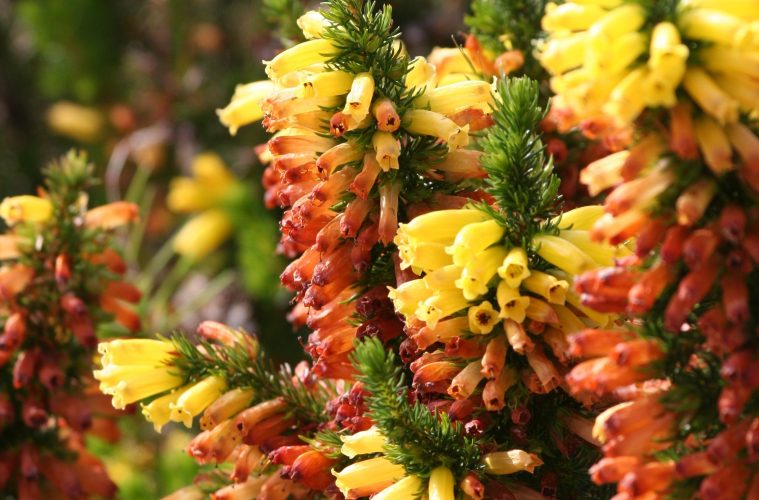
Another fynbos specialist, this colourful bird has an important relationship with indigenous ericas.
What it pollinates: Several bird-pollinated Erica species and other nectar-producing fynbos plants.
Where: The Western and Eastern Cape.
How: Its slender, curved bill allows it to reach nectar inside tubular flowers. Pollen is transferred between flowers as it feeds.
Did you know? Some Erica species have different flower colours despite being pollinated predominantly by the same sunbird species. This is one of the fascinating relationships researchers continue to study in the Cape Floristic Region.
13. Hawkmoths
Often mistaken for small birds because of their rapid wing movements, hawkmoths are important nocturnal pollinators.
What they pollinate: Various indigenous night-flowering plants, including some orchids and other long-tubed flowers.
Where: Across South Africa, in gardens, grasslands and natural vegetation.
How: Their long proboscises allow them to reach nectar deep inside flowers, while pollen attaches to their bodies.
Did you know? Some hawkmoths are important visitors to baobab flowers. Although baobabs are often associated with bat pollination, research in southern Africa has found that hawkmoths can be more frequent visitors.
14. Bee flies (Bombyliidae)
These fuzzy, often bee-like flies are another group worth looking out for.
What they pollinate: Various indigenous wildflowers, including some daisies and geranium relatives.
Where: Different species occur throughout South Africa, including the Western Cape and Namaqualand.
How: They hover in front of flowers and use their long mouthparts to drink nectar, sometimes transferring pollen as they move between blooms.
Did you know? Some bee flies can hover almost motionlessly while feeding, rather like tiny hummingbirds.
15. Sausage tree visitors: birds and other wildlife
The sausage tree (Kigelia africana) has an unusual pollination story of its own.
What they pollinate: The large, wine-coloured flowers of the sausage tree.
Where: Across much of tropical and southern Africa, including South Africa’s warmer regions.
How: Research in Kruger National Park found that birds are the most important pollinators. Glossy starlings, dark-capped bulbuls and southern masked weavers visit the flowers to feed on nectar, transferring pollen as they move between them.
Did you know? Despite the common association between sausage trees and bats, research in Kruger did not record bats visiting the flowers. Vervet monkeys and genets were also observed investigating or feeding from the flowers, although their contribution to pollination was not established.
ALSO SEE: Part 1: 4 types of pollination in your garden
