
 Bianca Muller
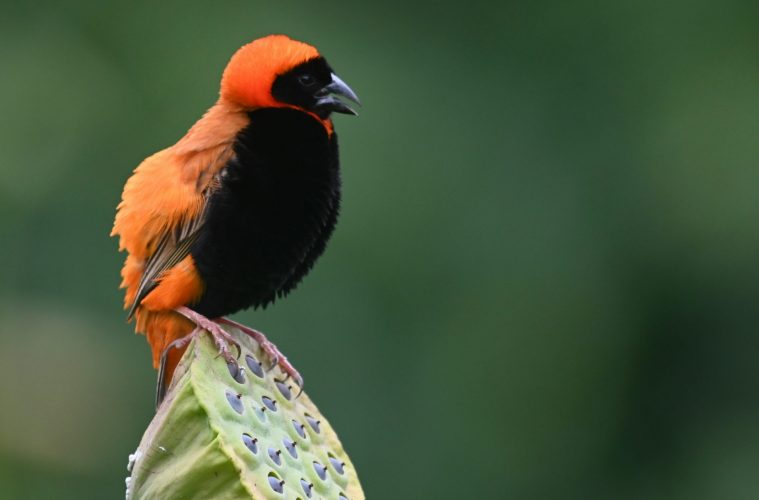
There is a good reason the Southern red bishop is one of the most eye-catching birds around wetlands and grassy areas. When breeding season arrives, the males swap their understated brown plumage for brilliant red and black feathers, turning even an ordinary reedbed into a lively display of colour and movement.
The Southern red bishop (Euplectes orix) is also a bird you may spot closer to home, particularly if your garden is near permanent water, tall grasses or reedbeds. Here is what to look for next time you hear a flurry of chirping around the garden.
How to identify a Southern red bishop
The easiest time to identify a Southern red bishop is during the breeding season, when the male is hard to miss.
Breeding males are about 10–11cm long and have striking red to orange-red plumage across the head, back and parts of the underparts, contrasting with a black face, throat, breast and belly. Their wings and tail are brownish, while their stout, conical bill is well suited to their mainly seed-based diet.
Outside the breeding season, however, they look very different. Both males and females have predominantly streaky brown plumage, making them considerably easier to overlook among grasses and reeds. Females are also smaller than males.
So if you have spotted a small brown bird in the garden and assumed it was just another sparrow-sized visitor, it is worth taking a closer look.
Where do Southern red bishops live?
Southern red bishops are widespread across southern Africa, although they are generally associated with areas that have access to permanent water.
They favour grassland and savanna, particularly places with tall vegetation, and are rarely found far from water. Reedbeds are particularly important because this is where they usually build their nests.
This explains why they can turn up in surprisingly urban settings. BirdLife South Africa records Southern red bishops breeding in reedbeds at places such as Durban Botanic Gardens and Walter Sisulu National Botanical Garden, where suitable wetland habitat is available.
For gardeners, that is a useful reminder that a wildlife-friendly garden does not have to be perfectly manicured. Tall grasses, natural vegetation and a source of shallow water can make a garden considerably more useful to local birdlife.
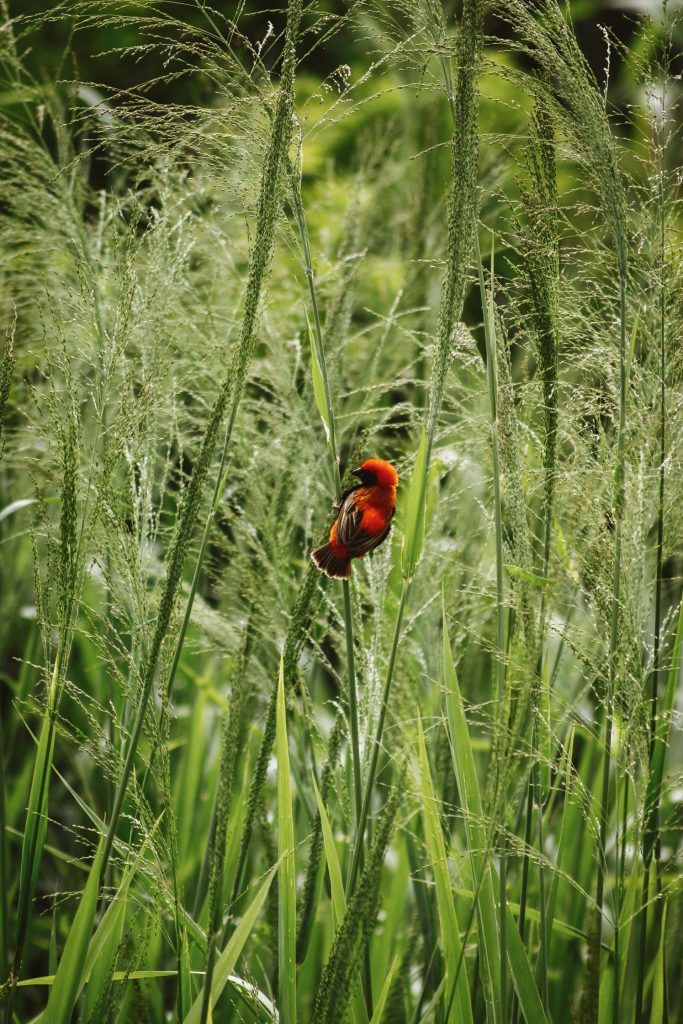
Photo: Pexels
What does the Southern red bishop eat?
Seeds make up much of the Southern red bishop’s diet. The birds collect seeds from plants and also forage on the ground.
They are not strict vegetarians, though. They also eat insects and other invertebrates and can even catch dragonflies and damselflies in flight. Young birds are fed insects and regurgitated seeds.
If you want to encourage seed-eating birds in your garden, consider allowing some grasses to mature and produce seed rather than cutting everything back immediately.
BirdLife South Africa also recommends using bird-friendly indigenous plants to provide natural food and habitat for garden birds.
The Southern red bishop’s impressive nest
The Southern red bishop is a member of the weaver family, and its nest-building skills are worth watching.
Males build several nests at the beginning of the breeding season in an attempt to attract females. The nests are generally constructed from grasses and other plant material and are woven between reeds or other stems.
The finished nest is enclosed, with a side entrance beneath a small projecting porch. Once a female has chosen a nest, she lays between two and four eggs, which are usually plain blue. Incubation takes around 12 to 13 days and young birds fledge after roughly two weeks.
The males also put on a display for potential mates, fluffing out their feathers, flying around the reedbeds and producing buzzing and chirping calls.
When do Southern red bishops breed?
Breeding times vary depending on where the birds live.
In the Western Cape, the breeding season generally runs from August to November, while elsewhere in southern Africa it can take place between November and March.
This means spring is an especially good time to keep an eye out for brightly coloured males, particularly around wetlands and reedbeds.
How to attract Southern red bishops to your garden
You cannot guarantee that a Southern red bishop will visit your garden, but you can make your outdoor space more useful to birds.
Keep some grasses: Allowing suitable grasses to flower and produce seed can provide a natural food source.
Add water: A shallow birdbath can provide drinking and bathing opportunities. Keep it clean and refresh the water regularly.
Create cover: Dense grasses, shrubs and other vegetation give small birds places to feed and seek shelter.
Choose indigenous plants: BirdLife South Africa recommends bird-friendly indigenous planting because local birds and insects are more likely to make use of suitable plants.
Avoid making the garden too tidy: Leaving some seed heads, leaf litter and natural vegetation can provide food and shelter that a heavily manicured garden does not.
Keep an eye on the reeds
The next time you are near a wetland, dam or reedbed, listen before you look. A flurry of buzzing calls and movement among the reeds could reveal a colony of Southern red bishops.
And if you spot a flash of red and black bouncing between the grasses, you have probably found one of South Africa’s most colourful little garden and wetland birds.
Source: Information supplied by the South African National Biodiversity Institute (SANBI), with additional habitat information from BirdLife South Africa.
ALSO SEE: Garden bird of the week: Pin-tailed Whydah
Feature image: Unsplash
