
 Jade Mcgee
A first apartment has a particular quality before anything is done with it. Clean, neutral, anonymous. The walls are white or close to it. The floors are bare. The light falls on nothing. It does not feel like it belongs to anyone yet, and that can make it feel like it does not belong to you. The good news is that this state is entirely temporary, and the transition from empty to genuinely inhabited is more about understanding a few design principles than it is about budget.
Anchor each room with a rug
In a rented apartment where the floors are likely hard, and the walls cannot be changed, a rug is the single highest-impact addition you can make. It defines zones, absorbs sound, anchors furniture into a coherent arrangement and brings warmth to a surface that reads as cold and transient without it. Size matters more than most people realise: a rug that is too small for the space it is meant to anchor looks like an afterthought. In a living area, all the front legs of the main seating pieces should sit on it. In a bedroom, the rug should extend at least 60 centimetres beyond the sides and foot of the bed.
Address the lighting first
Overhead ceiling fixtures in rental apartments are almost universally unpleasant: bright, flat and institutional. The quickest way to transform the quality of a space after moving in is to add lamps. A floor lamp in a corner, a table lamp on a side table or beside the bed, and warm-toned bulbs throughout, approximately 2700K, change the entire character of a room without touching a wall or a fixture. Lamps create pools of warm light rather than the flat, even illumination of a central ceiling light, and rooms lit from multiple lower sources feel considerably larger, warmer and more deliberate than the same room lit from a single point above.
Create at least one composed surface
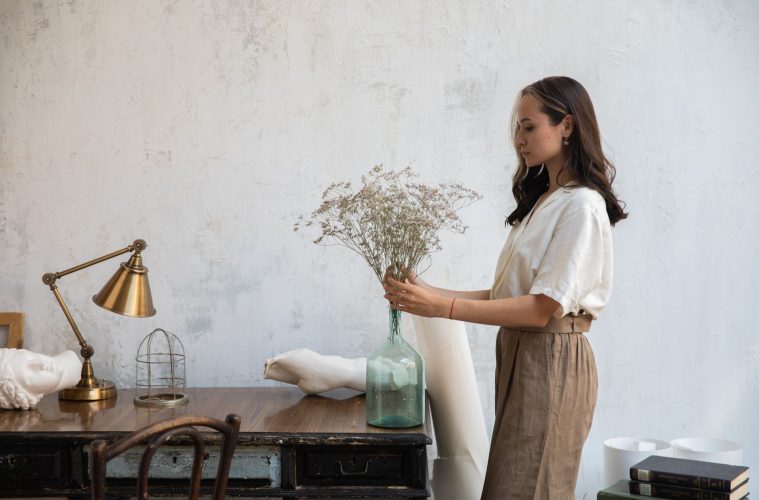
The visual quality of an apartment is largely determined by its horizontal surfaces: sideboards, bookshelves, windowsills, and the area next to the kitchen sink. Leaving all of these empty makes the space look temporarily occupied. A single shelf or tabletop arranged with three to five objects of varying heights, a plant, a small object of personal meaning, a candle, a book lying flat as a base creates a composed surface that signals intention and habitation. The objects do not need to be expensive or coordinated, but they should be considered.
Use plants as architecture
In a space with limited means for permanent structural changes, plants do some of the work of architecture. A tall, large-leafed plant in a corner defines the corner, fills dead space and introduces the organic visual movement that makes any room feel more alive. A collection of smaller plants on a windowsill creates a threshold between inside and outside. Plants in an apartment are not decoration in the conventional sense; they are spatial tools. Choose species that suit the light your apartment actually receives rather than the light you wish it had: a snake plant or pothos in a low-light apartment will thrive; a fiddle-leaf fig in the same conditions will fail.
Hang things on the walls early
Bare walls are the most reliable indicator of a space that has not yet been inhabited. A single print or poster, even temporarily tacked rather than properly framed, immediately reduces the impermanence of a space. A small gallery arrangement above a sofa or desk can be assembled over time rather than all at once. The critical rule for hanging anything in an apartment is height: most people hang things too high. The centre of any artwork or grouping should sit at eye level when standing, approximately 150 to 160 centimetres from the floor. Hanging at this height makes the room feel grounded rather than like the walls are floating.
Manage storage visibly
The difference between a well-designed small apartment and a cluttered one is usually not square meterage but the visibility of storage decisions. Open shelving that displays books, ceramics and functional items in a considered arrangement reads as designed. The same items stacked randomly on the same shelf read as disorganised. In a first apartment where custom cabinetry is not an option, finding affordable open shelving, a freestanding bookcase, a storage bench, a coat rack that doubles as a display, and using it thoughtfully is where the interior character of the space is largely created.
ALSO SEE:
Connect your home with nature: Indoor-outdoor living made simple
Featured Image: Pexels
