
 Bianca Muller
The call of the Laughing Dove is one of those garden sounds that can become instantly recognisable once you’ve heard it a few times.
The Laughing Dove (Spilopelia senegalensis) is a widespread species in South Africa and one that has adapted well to living around people. It is often seen on the ground, where it walks about in search of seeds, rather than spending all its time perched high in trees.
Why is it called a Laughing Dove?
The name comes from its characteristic call, a series of soft, rhythmic notes that can sound a little like quiet laughter. It is a particularly useful clue when identifying one because the bird itself can be easy to overlook among the browns and greys of a garden.
What does a Laughing Dove look like?
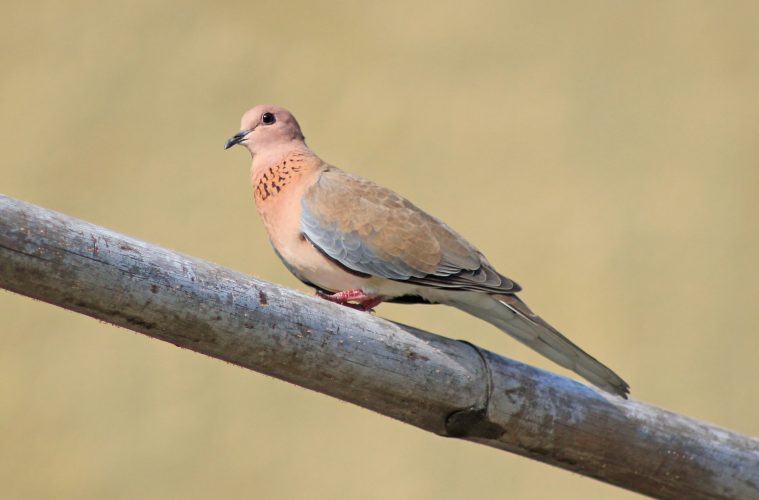
The Laughing Dove is a relatively small dove with a slender body, long tail and reddish legs. Its plumage is predominantly pinkish-brown and sandy in colour, with paler underparts.
Look at the neck and upper breast and you’ll notice its most distinctive marking: a dark patch covered in pale-edged feathers that creates a scaled appearance. The head is greyish, while the wings are brown with darker markings.
Males and females look broadly similar, so the combination of colouring, markings and call is more useful for identification than trying to distinguish between the sexes.
What does the Laughing Dove eat?
Forget the bird feeder for a moment and look at the ground. Laughing Doves spend much of their feeding time foraging on the ground for seeds and other plant material.
This makes a garden with some open, accessible areas particularly useful. Seed-producing plants can provide natural food, while a small patch of bare ground or short grass gives ground-feeding birds somewhere to search for fallen seeds.
If you put out supplementary bird food, keep feeding areas clean and avoid allowing old food or droppings to accumulate. Providing a variety of natural food sources, shelter and fresh water is a better long-term approach than relying solely on feeders.
How to make your garden Laughing Dove-friendly
You don’t need to transform your garden into a wildlife reserve to make it more welcoming to Laughing Doves. A few simple features can make a difference.
Leave some open ground: Laughing Doves are ground feeders, so don’t cover every available space with paving, thick groundcovers or dense planting.
Grow seed-producing plants: Allowing some plants to flower and set seed can provide a natural food source for visiting birds.
Add a shallow birdbath: Fresh, clean water is useful for drinking and bathing. Position it where birds have a reasonably clear view of their surroundings and nearby vegetation where they can retreat.
Provide cover: Shrubs and trees give birds somewhere to perch and shelter between feeding visits. They can also provide potential nesting sites.
Keep an eye out for nests
Laughing Doves can nest around human habitation, building relatively simple nests from twigs and other plant material. Their nests can be surprisingly easy to miss, particularly when they’re tucked into vegetation.
If a pair of doves suddenly starts visiting one particular shrub or tree repeatedly, it’s worth checking carefully before pruning. What looks like an untidy collection of sticks could be a nest in progress.
ALSO SEE: Garden bird of the week: Dikkop
Feature image: Unsplash
