

 Bianca Muller
With its scruffy crest, long tail and mouse-like movements through the branches, the speckled mousebird is an interesting visitor to have in your garden. Here’s how to identify this sociable bird and what attracts it to outdoor spaces.
Not every garden visitor arrives with a bright splash of colour. Some are a little more understated, and the speckled mousebird is a good example. With its soft brown plumage, distinctive crest and unusually long tail, this bird might not be the most colourful in the garden, but its lively behaviour makes it difficult to overlook.
Known scientifically as Colius striatus, the speckled mousebird is a familiar sight in many parts of South Africa, particularly in the eastern and northern regions. It is often spotted moving through trees, shrubs and dense vegetation, usually accompanied by several others.
If you’ve noticed a small group of brown birds clambering through your garden bushes, there’s a good chance you’ve encountered these curious characters.
How to identify a speckled mousebird
The speckled mousebird has a fairly understated appearance, with sandy-brown to greyish-brown plumage, slightly darker markings and warm brown underparts. However, a few features make it easier to recognise.
Its most noticeable characteristics are its long, stiff tail feathers and raised crest, which gives its head a slightly untidy appearance. It also has a distinctive two-toned bill, with a dark upper section and a pale lower section, as well as a dark facial mask.
Adults measure approximately 30 to 35cm from head to tail, although much of this length comes from their tail feathers. Males and females look alike, making it difficult to distinguish between the sexes when watching them in the garden.
One of the easiest ways to identify a speckled mousebird is by watching how it moves. Unlike many garden birds that hop from branch to branch, mousebirds are excellent climbers. They shuffle sideways, clamber through foliage and sometimes hang upside down while looking for food.
Their long tails also help them balance as they navigate branches.
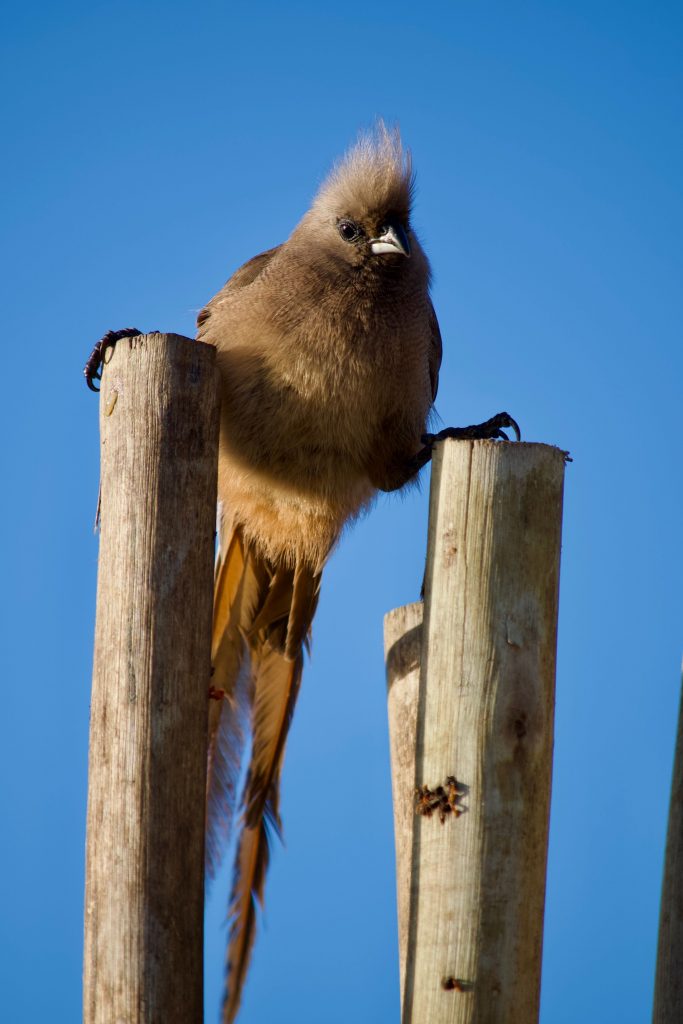
Photo: Pexels
Where are speckled mousebirds found in South Africa?
Speckled mousebirds occur across much of eastern and southern sub-Saharan Africa. In South Africa, they are particularly associated with the eastern half of the country, including parts of KwaZulu-Natal, Mpumalanga, Limpopo, Gauteng and the Eastern Cape.
They favour habitats with plenty of vegetation, including woodland edges, bushveld, thickets, orchards and well-established suburban gardens.
Although they are common in many areas, they are less frequently encountered in the drier western parts of the country.
In residential gardens, they are often attracted to fruiting trees and shrubs, particularly where there is enough dense vegetation to provide shelter and suitable places to roost.
What do speckled mousebirds eat?
Speckled mousebirds have a largely plant-based diet. They feed on a variety of fruits, leaves, flowers, buds and nectar, moving through trees and shrubs in search of their next meal.
Fruiting plants are particularly important to them, which is one reason they are regular visitors to gardens with established fruit trees.
Their diet can also include seeds and small invertebrates, such as termites and ants.
If you would like to make your garden more appealing to these birds, consider planting indigenous fruit-bearing trees and shrubs suited to your region. A variety of flowering plants can also provide additional food sources throughout the year.
Keep in mind that mousebirds can occasionally help themselves to fruit before you’ve had a chance to pick it. If you have fruit trees, you might find yourself sharing a harvest or two.
A sociable garden visitor
Unlike some garden birds that prefer to keep to themselves, speckled mousebirds are highly sociable. They are usually seen in groups, often numbering between five and 20 individuals.
These groups move through vegetation together, keeping in contact with one another through a series of rather harsh, chattering calls. Their flight is also distinctive, with birds often travelling in a loose, straggling line.
Their social behaviour extends beyond feeding. Speckled mousebirds regularly groom and sunbathe together, and they have an unusual way of keeping warm at night.
When it’s time to roost, several birds may huddle closely together on the same branch, pressing against one another for warmth.
On cooler mornings, you might also spot them perched in the sunshine with their feathers fluffed up and their bodies spread out to absorb the warmth.
The speckled mousebird is not considered threatened and has adapted well to a variety of habitats, including suburban gardens. By providing food, shelter and water, you can help make your garden a more welcoming space for these sociable birds and plenty of other feathered visitors.
ALSO SEE: Garden bird of the week: Southern red bishop
