
 Jade Mcgee
The orchid’s reputation for difficulty is largely undeserved, and it has discouraged many gardeners from one of the most rewarding houseplants available. The confusion usually comes from treating orchids like ordinary potted plants, which they are not. In their natural habitat, most of the orchids sold in SA nurseries are epiphytes: plants that grow on trees, with roots exposed to air, bright filtered light and alternating wet and dry conditions. Once you understand that context, the care requirements make immediate and logical sense.
Choosing the right orchid to start with
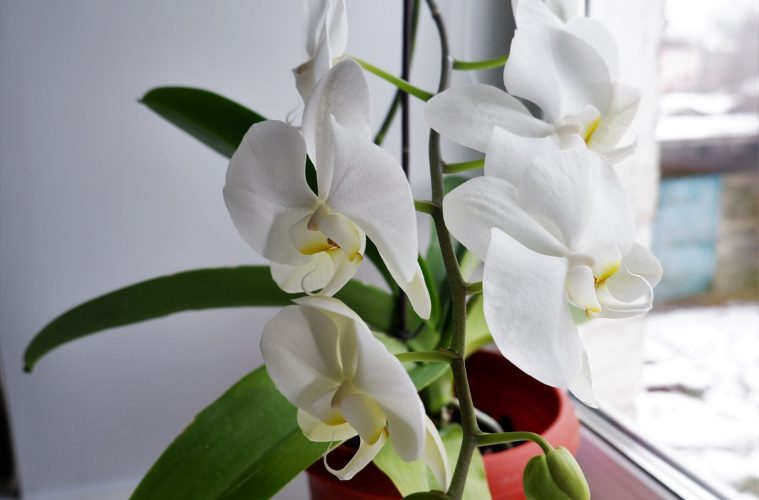
Phalaenopsis, the moth orchid, is the correct starting point for anyone new to orchid growing. It is the most widely available orchid in South Africa, the most tolerant of imperfect conditions, and the one most likely to rebloom reliably when given the right conditions. Its flat, paddle-shaped leaves and long arching flower spike bearing multiple blooms in white, pink, purple or yellow make it one of the most visually compelling houseplants available at any price point. Everything in this guide applies primarily to Phalaenopsis, though the principles translate to most other popular indoor orchid types including Dendrobium and Oncidium.
Light
Phalaenopsis orchids need bright, indirect light. In practice, this means a position near an east-facing window, or back from a south-facing window where some screening prevents the leaves from receiving direct midday sun. Direct sun on the leaves causes bleaching or scorching: affected leaves turn pale yellow or develop sunken brown patches. Too little light produces dark green, floppy leaves and prevents flowering. The correct light level produces leaves that are a medium, slightly yellow-green, firm and upright. This is the most reliable indicator that light levels are correct.
Watering: the most important variable
More orchids are killed by overwatering than by any other cause. Phalaenopsis roots need to alternate between wet and dry: water thoroughly, allow to drain completely, then allow the roots and medium to dry out before watering again. In most SA homes, this means watering every seven to ten days in summer and every ten to fourteen days in winter, adjusting based on how quickly the bark medium dries in your specific conditions.
The clearest indicator is the roots themselves, which are visible through a transparent pot. Healthy hydrated roots are plump and green. Roots that have dried out sufficiently to need water appear pale silver-grey. Water when they reach this silver state. Always water with room-temperature water rather than cold water, which can shock the roots. Allow excess water to drain fully from the pot rather than leaving the plant sitting in a saucer of water, which causes root rot.
Crown rot is another common problem caused by water pooling in the central rosette of leaves at the top of the plant. Water the growing medium from the side or from below, never directly into the crown. If water does collect there, blot it out immediately with a paper towel or tissue.
Potting medium
Orchids do not grow in soil. Their roots need air circulation, which means they must be grown in a coarse, open medium rather than a dense, moisture-retaining potting mix. Bark-based orchid mix, widely available at nurseries and garden centres in South Africa, is the standard choice. It allows the wet-dry cycling that epiphytic roots require and does not compact around the roots in the way that soil does. Clear or semi-transparent plastic pots allow you to observe root health and moisture status through the container walls, which is a significant practical advantage.
Temperature and the key to reblooming
Phalaenopsis orchids thrive at temperatures between 18 and 27 degrees Celsius during the day, which is comfortable indoor temperature across most of SA. The critical and often overlooked factor for triggering a new flower spike is a temperature differential: a drop of at least five to seven degrees between day and night temperatures for several consecutive weeks. In many South African homes, the natural temperature drop of an autumn or winter evening provides this trigger without any intervention required. Placing the orchid in a position where it experiences this natural temperature variation, near but not in a draught, is usually sufficient.
Feeding
Feed with a diluted balanced fertiliser formulated for orchids every two weeks during the active growing season from spring through early autumn. The practical rule for orchid feeding is to dilute to a quarter of the recommended strength and apply with every second watering: it is significantly easier to underfeed an orchid than to damage it through over-fertilising, which causes salt accumulation around the roots. Reduce feeding to once a month in winter when growth slows.
After flowering
When the last flower drops, cut the spike above the second node counting from the base. This sometimes prompts the plant to produce a secondary spike from a lower node rather than dying back entirely. If no new spike appears within eight weeks, cut the spike at the base. Continue regular care through the resting period and the plant will typically produce a new spike the following autumn when day-night temperature differentials return. An orchid that never reblooms is almost always in insufficient light or not experiencing sufficient temperature variation.
Common problems
Yellowing leaves are caused by direct sun, overwatering or natural ageing of the lowest leaves, which yellow and drop as the plant grows upward. Wrinkled, accordion-pleated leaves indicate dehydration. Soft, dark or mushy roots visible through the pot indicate root rot. Brown or black patches on leaves are usually sunburn or fungal spots caused by standing water. Limp, pale leaves despite adequate watering suggest root rot has compromised the plant’s ability to absorb water, requiring unpotting, trimming of affected roots and repotting in fresh bark.
ALSO SEE:
Featured:
