
 Jade Mcgee
There is a quality that distinguishes a room that feels resolved from one that does not, and it is easier to identify in its absence than to define directly. A room that lacks it has interesting individual elements that do not quite hold together: a rug that sits in isolation from the upholstery, a colour in the artwork that appears nowhere else in the space, a chair that seems to belong to a different conversation from the sofa it accompanies. The design principle that addresses this is repetition, and it is both the simplest and one of the most consistently underused tools in interior design.
What repetition actually means
In design terms, repetition is the deliberate recurrence of an element, whether colour, shape, texture, material or pattern, at multiple points within a space. It creates what the eye reads as visual rhythm: the sense that a design decision was made rather than accumulated. A colour that appears in the sofa upholstery, recurs in the artwork above the fireplace and appears again in a cushion on an armchair registers as a choice. The same colour in only one location registers as an item.
Repetition also creates the calm, resolved quality that makes rooms feel comfortable to be in for extended periods. The eye completes its survey of the space, finds the recurrent elements, and settles. Spaces without repetition demand constant visual renegotiation, which is tiring in a way that is difficult to identify but easy to feel.
Start with colour
Colour is the most straightforward place to introduce repetition because the same pigment can travel across entirely different objects, surfaces and scales without requiring any uniformity of material, finish or scale. Pick three to five key colours from your scheme and trace where each one appears across the room. If any colour appears only once, find a way to echo it, however quietly. A cushion, a small ceramic, a book spine, a plant pot. These are small objects but they complete the visual circuit of the room.
Avoid using the same colour in the same proportion at multiple points in the room, which creates symmetry rather than repetition. A dominant sofa colour that is exactly matched on the opposite wall and again on the central rug creates visual monotony rather than harmony. Let the colour repeat but vary its proportion and the weight it carries at each recurrence.
Layer texture through soft furnishings
Textile repetition is one of the most accessible and immediately effective approaches. The recurrence of a texture, natural linen, woven rattan, sheepskin, velvet, across different objects within the same room creates a thread of cohesion that does not require matching and does not constrain the rest of the scheme. A linen cushion on the sofa, linen panels at the windows and a linen throw draped over an armchair form a textile story without any of the pieces being identical.
Mixing textures within the same tone family, warm neutrals, for instance, allows you to create visual richness through surface variation rather than colour contrast. A room in which every surface has a different tactile quality but all sit in the same warmth register feels layered and considered without being complicated.
Repeat shapes and motifs
Shape repetition is subtler than colour or texture but equally powerful. A curved leg on a sofa that is echoed in the rounded edge of a coffee table, a pendant light whose silhouette mirrors the arc of a doorway arch, a series of circular objects on a shelf that rhyme with a round mirror: these connections are rarely noticed consciously but consistently contribute to the sense of a room that has been designed rather than assembled. Pattern carries shape repetition at a compressed scale. A geometric print on a cushion that contains the same proportion of circle to rectangle as the window panes above it is making the same connection at a different register.
Symmetry as a particular form of repetition
Symmetry is the most formalised version of repetition: exact mirroring of elements on either side of a central axis. Two identical bedside lights flanking a bed, matching chairs on opposite sides of a fireplace, paired sconces on either side of a console: these are classical moves that the eye reads as orderly and resolved. Symmetry creates comfort through predictability. It works best in spaces where calm and formality are the desired atmosphere.
Not every room should be symmetrical, and strict symmetry in a casual living space can feel sterile. The alternative is near-symmetry: two chairs that are related but not identical, lamps that share a form but carry slightly different scales, a repetition that reads as balanced without being exactly mirrored. This is often where rooms feel most interesting.
Accessories as the completing layer
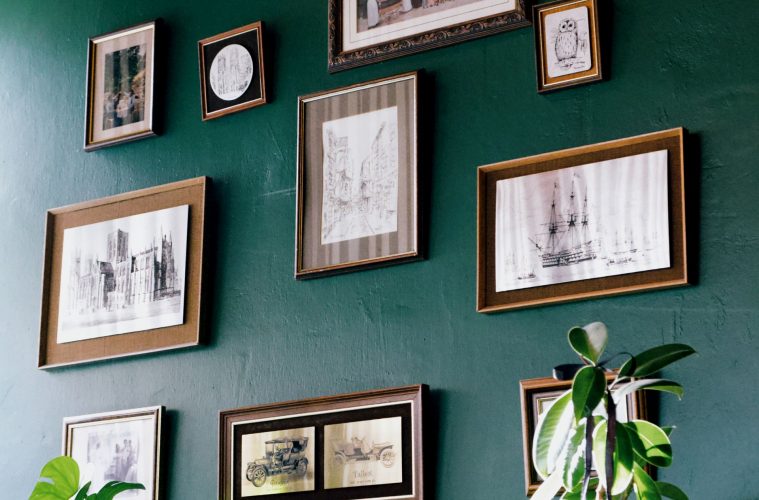
Accessories carry the final layer of repetition: the objects, artworks and collected pieces that tie individual decisions together across the room. A set of ceramics in related tones but different shapes, a series of artworks whose frames share a material, a cluster of vessels in varying heights that repeat the shape of a plant nearby: these finishing touches are where the scheme is completed or where it falls apart. Choose accessories that echo at least one element already present in the room, whether in colour, material, form or scale, and the room will feel finished in a way that is difficult to achieve through any other means.
ALSO SEE:
Featured Image: Pexels
