 Maegan-Leigh Jacobs
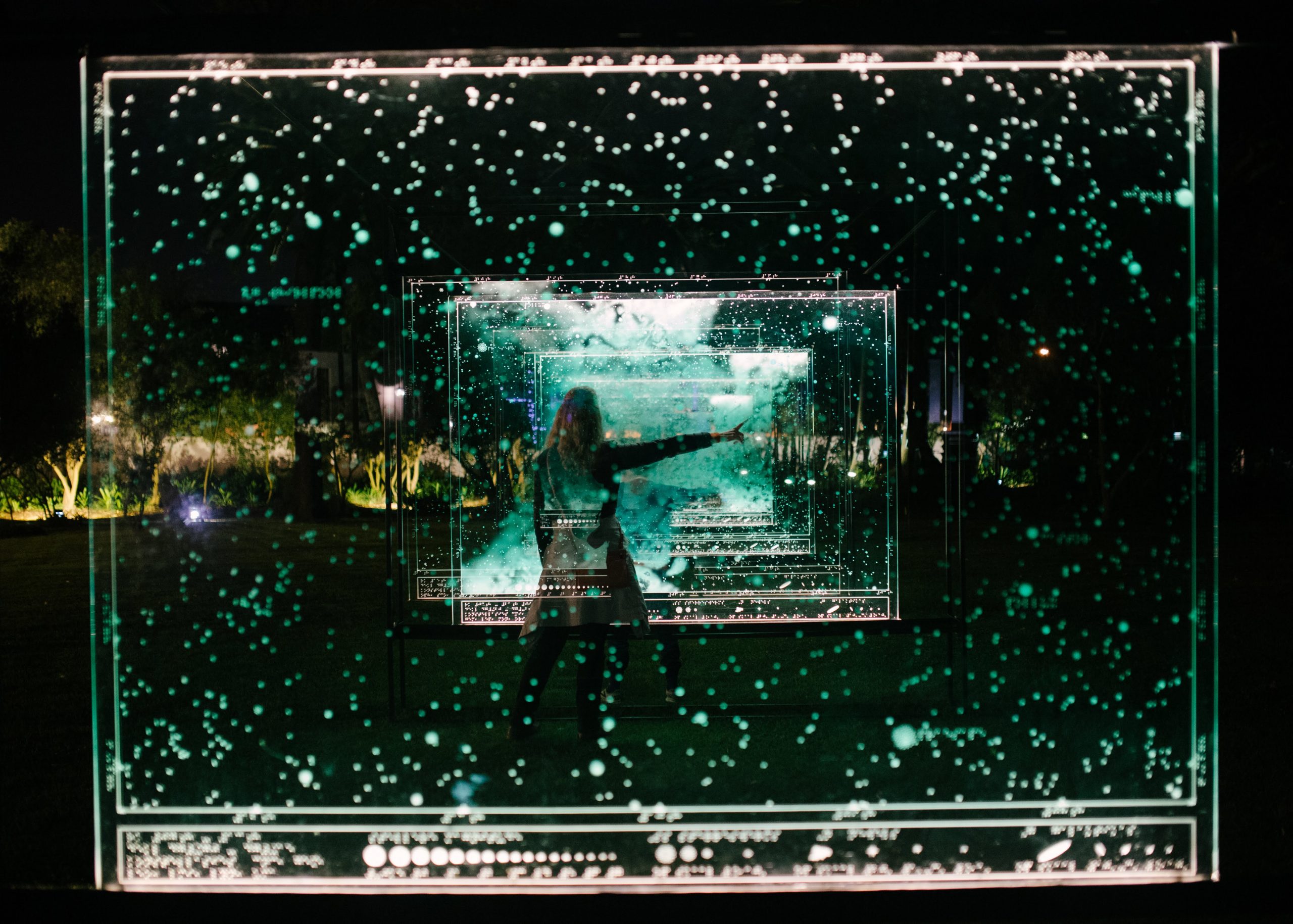
Spier Light Art returns for its eighth edition, transforming the historic Stellenbosch wine farm into a nocturnal landscape of contemporary art. As night falls, works glow, shimmer and shift across the grounds, inviting visitors to experience light as both medium and meaning.
For this year’s edition, running from 6 March to 6 April 2026, curators Vaughn Sadie and Jay Pather have selected works from 21 South African artists that probe environmental crises, social memory and post-apartheid realities, alongside more abstract explorations of perception, technology and the cosmos.
Unlike a conventional exhibition, visitors navigate the farm at night, encountering artworks along winding paths.
Sadie says there is no fixed route, no prescribed experience.
“The exhibition invites audiences to immerse themselves in the sensual and ephemeral interplay of light and sound, allowing curiosity and intrigue to guide their journey.”
“At its core, light art is more than illumination: it is a lens through which we perceive, reflect and question the world.”
The artists, selected from an open call, were invited to explore light in all its conceptual, socio-political and cultural dimensions.
“It’s often a very intuitive decision to cluster a group of works together in the landscape,” says Sadie. “Something about their scale or composition sets up an interesting dialogue that speaks back to the curatorial semantics across the whole exhibition. This year, there are the direct and immediate neon text pieces that celebrate the South African vernacular, whilst other works illuminate unexpected intersections between technology, infrastructure and the natural environment.”
“Light determines time. It’s a rare opportunity to step away from the glare of screens and experience light in its most elemental form, allowing visitors to wander freely in the company of strangers, similarly transfixed by the effects of the nocturnal interplay of light and sound,” says Sadie.
While there is no fixed theme, the curators are well-attuned to how the light conditions of everyday life determine human safety, wellbeing, literacy and privilege.
“Shared thematics emerge each year from the artworks shortlisted from the open call. This year, it’s very much a collective kind of exhibition. There’s a shared interest in memory and ways of accessing the past,” says Pather.
“If you look at Kenneth Shandu’s work, with the umbrellas and the soundtrack of the rain, for instance, for me, it’s less about the environment and more about the lack of service delivery. Even though parts of Khayelitsha end up underwater every winter, there is this infuriating lethargy in relation to transformation. And people are starting to realise what’s really up. This is a curatorial framing that has begun to emerge: taking the time to think and reflect on the forms that have brought us to where we are.”
This year the exhibition will continue its international exchange program, welcoming Swiss artists Florian Bach and Kerim Seiler, whose site-specific projects respond to the South African context, creating a dialogue between local and global perspectives on contemporary light art.
View this post on Instagram
The artists and their light art
Chelsea Holland | THE GREY AREA IN THE CAPE WINELANDS
This project uses a complex, interactive system built with motion-design software. Within the digital space, a cloud of dust particles drifts as if stirred by a gentle breeze. At the centre, a cube of RGB light interacts with these particles, but the cube itself remains invisible. A camera positioned at eye level captures only the face of the viewer within a square frame. As the particles move through the unseen cube, their colours blend and shift, creating the vibrant visual experience that visitors see. The work emerges from interdisciplinary research exploring how humans perceive and relate to both the visible and invisible aspects of the world around them.
David Brown | DOG WATCH I
A permanent piece at Spier, Brown’s work channels memories of Apartheid-era violence and societal injustice, using sculpture to transform trauma into visual storytelling that resonates across time and place.
Florian Bach | SPILL
Twelve industrial lamps flood a riverbank with relentless light, transforming a natural space into a zone under constant surveillance. Bach’s installation confronts audiences with human control over the environment, turning brightness into intrusion and reflection on social and ecological consequences.
Jenna Burchell | SONGSMITH
A permanent installation at Spier, Burchell’s interactive sound installation fuses digital and natural elements, creating vessels for memory and storytelling. Visitors engage with sculptural sound objects that preserve and share layered narratives through touch and sound.
Joe Turpin | ‘EISH’
Neon letters and playful text capture the frustrations and contradictions of post-1994 South Africa. Turpin’s work invites reflection on everyday life, identity and the promises of a democratic society. The artwork invites viewers to ask themselves: What has made you say ‘eish’ lately?
Kenneth Shandu | WHEN THE SKY FALLS
When the Sky Falls reflects on South Africa’s devastating floods and the resilience of affected communities. These recurring disasters, intensified by climate change, poor urban planning and social inequality, result in loss, displacement and the ongoing vulnerability of those most affected. Using illuminated umbrellas as symbols of protection and remembrance, the work invites viewers into a shared space of reflection and hope, highlighting the urgent need for climate justice and collective care.
Kerim Seiler | PNEUMA, SOMNAMBUL
A dynamic, travelling public sculpture composed of single beams, knotted to tetrahedral cells adorned with vibrant, blinking fluorescent lights, Seiler’s work engages deeply with its surroundings. The sculpture’s dynamic lighting contrasts with both natural landscapes and urban environments, creating an ethereal presence that invites viewers to slow down and reflect.
Kunye Collab | LUMEN VITAE
Lumen Vitae (Latin: Light of Life) explores the profound symmetry between the human body and the cosmos. Two circles of light pulse within one another with an inner orb embraced by a larger one, evoking both a blazing sun and a living cell. This duality speaks to the universal geometry that connects all existence: from nuclei to galaxies, life unfolds in cycles and spirals that bind everything together.
Mawande ka Zenzile | UBUGQI
A neon text work embodying the isiXhosa concept of “ubugqi” – profound intuitive knowledge. Zenzile’s installation views the spark or glow of the neon light as a metaphor for profound awakening in contemporary art, in which neon text works have a prominent history, juxtaposed with indigenous Southern African mysticism. It is an encouragement to get out of one’s head, stop thinking ‘what does this mean’, and fully experience the moment and the work.
Noa Hall | SENTINEL
An experimental documentary installation tracking Johannesburg’s Braamfontein Spruit and its pylons, Sentinel transforms industrial structures into spectral forms. These parallel circuits of water and electricity, ecology and infrastructure, reveal layered connections and interdependence. The work preserves space for both secular ritual and spiritual practice, tracing how these steel guardians shape land and daily rhythms.
Paul Thabo Nhlapo | FIDDLEARTH
Through animation and mixed media, Nhlapo explores post-Apartheid identity, mental health, injustice and masculinity. Fiddlearth explores how individuals navigate belonging, vulnerability, and resilience in a society marked by inequality and transformation. It invites viewers to pause and reflect on how we relate to one another and to the world around us, suggesting that, even in the face of struggle and change, creativity offers a space for healing and collective understanding.
Qondiswa James, Nathalie Ponlot, Themba Stewart & Jonathan O’Hear | SAFE IN THE SHADOWS
An interactive installation that reclaims darkness as sanctuary, a network of cairns – stone, translucent resin and salvaged remnants – linked by root-like conduits that echo mycelial threads and neural pathways, combine light, mirrors and digital feeds, exploring memory, ancestral traditions and resistance to compulsory visibility.
Renée Holleman | UNDER THE OVERGROWTH IS NO SMALL MEASURE OF SUNLIGHT
Holleman celebrates the overlooked weeds: ‘plants out of place’, reminding us of the veering, queering and rebellious dynamics of living things. The work draws a connection between light as a spectrum of frequencies, which plants utilise for growth, and nature’s vibrant biodiversity, inviting reflection on how acts of unmaking and undoing, can enable creative, generative and surprising ways of being in the world.
Ronald Abdou & Zachary Stewart | BURNING
This collaborative installation explores how conflict is experienced in the digital age. At its centre, a car burns symbolising the now-familiar spectacle of violence, surrounded by multiple viewing points designed as social media frames. This work interrogates the disparity between those who live within the spectacle of violence and those who spectate from afar, questioning how empathy, awareness and detachment are shaped by digital platforms.
Sam ‘/XAM’ Fortuin | ONTHOU
Onthou is an audio-visual short film of a recurring dream that begins and ends on the edge of a kelp forest on the coast of Cape Town. Emerging from the waters with the sound of a bow, is a dream-walker who leads us to a secret place on the beach under a boulder. In this story, water is the portal into the dream realm. Journeying into the ancestral dreamscape, the rules of engagement with space are subverted. As symbols of South Africa’s colonial heritage, the sites of Taal Monument (1975) and Rhodes Memorial (1912) both occupy domineering positions on the mountains. By framing the story that unfolds at these two sites in the realm of the ancestral dreamscape, Onthou becomes a reminder that change is an inevitability.
Stephen van den Heever & Amy Leibbrandt | A MOMENT OF REST FOR THOSE WHO CAN’T
Positioned between the trees along the Eerste River, this artwork engages with the notion of rest for those attending and in honour of those who can’t. The semi-circular structure is designed to guide a slow unveiling of the surrounding landscape in a world filled with anxiety. As one approaches, the fabric fins frame the natural setting, offering a changing perspective. This obscuring and revealing of the scene craft a secluded space for a moment of rest in the soft light.
Strijdom van der Merwe | ARTIFACTS
Van der Merwe reimagines colonial artifacts, replacing Dutch designs with indigenous San and Khoe rock paintings along with influences of Chinese imports used in Cape Dutch homesteads and the VOC. This artwork interpretation is a ‘dual acknowledgment’ and can be seen as a symbol of dual recognition, capturing the essence of the country’s diverse heritage.
Thando Mama | ‘1994 (I)’ (REVISITED)
A multi-media reflection on South Africa’s journey since 1994, Mama’s installation aims to capture resilience and memory. The interplay of light, reflection and sound transforms the space into a contemplative environment, inviting viewers to connect personally with the country’s history and socio-political dynamics. This work invites engagement with our collective history, to question, reflect and connect on our shared journey toward understanding, healing and forging a new narrative.
Theytjie | CLOSER TO HARM THAN HOME
Closer to Harm than Home is a short film that explores the ongoing impact of gun and gang violence on Cape Flats. Moving beyond the statistics and headlines, the film centres the human reality of conflict by foregrounding the resilience, fear and enduring spirit of those who navigate daily life. An individual’s daily commute, walking and using taxis, is reframed as a precarious act of survival through the symbolic flat blocks which are living reminders of Apartheid legacies and systemic neglect. While acknowledging struggle, it reframes the communities as living examples of agency and innovation.
Tiago Rodrigues | THE SOUND OF MY VOICE
A permanent collection at Spier Wine Farm, The Sound of My Voice, an intervention in response to the farm’s slave bell. The artwork stands to personify the bell, to propose that the bell’s ringing can become an echo of the country’s past and the oppressive system of slavery, reminding viewers of those whose memory is stained by systems of oppression. It brings a different presence to an object that once held so much power.
Wezile Harmans | ENDLOVINI AS A FORM OF ARCHIVE
Endlovini as a Form of Archive is an installation that dwells in the tension between fragility and resilience. Built from found objects, silk, mutton cloth, thread and wood, it becomes both a shelter and memory site, a space where survival transforms into resistance. Inspired by the act of Ukundlova – informal land identification and occupation – the work foregrounds how necessity creates communities and asserts presence against systemic neglect.
Spier Light Art | 6 March – 6 April 2026 | Daily at dusk
Bookings for entry and sunset picnics can be booked on Dineplan
ALSO SEE: SPIER’S EXCLUSIVE VILLAS REFDINE COUNTRY LUXURY
