
 Bianca Muller
Books are usually treated as something that needs to be stored. Line them up on a shelf, organise them by size or colour and, if you’re feeling particularly brave, turn a few of them around for that minimalist look.
But books can do far more than fill a bookshelf. They can become side tables, plinths, wall art and even part of a room’s architecture. And because they already have colour, texture and plenty of personality, they’re one of the easiest ways to add character to a home without buying another piece of décor.
So, instead of asking where your books should be stored, ask where they could be used.
Make a tiny side table
A substantial stack of hardback books can become an unexpected side table beside a sofa or armchair. Look for larger, sturdy books and build the stack from biggest to smallest, checking that it remains stable as you go.
Top it with a small tray, lamp or ceramic object, or leave the final book visible. It’s not intended to replace a properly constructed piece of furniture, but as a decorative, temporary surface it can be wonderfully quirky.
Give your favourite object a pedestal
Sometimes a small object gets lost among everything else on a shelf or console. A stack of books gives it some height and makes it feel like a deliberate focal point.
Try placing a vase, sculpture, vintage object or small plant on top of two or three books. The combination works particularly well when the subject of the books relates to the object. A botanical book beneath a plant or a travel book beneath a souvenir, for example, adds a little story to the arrangement.
Create a book tower
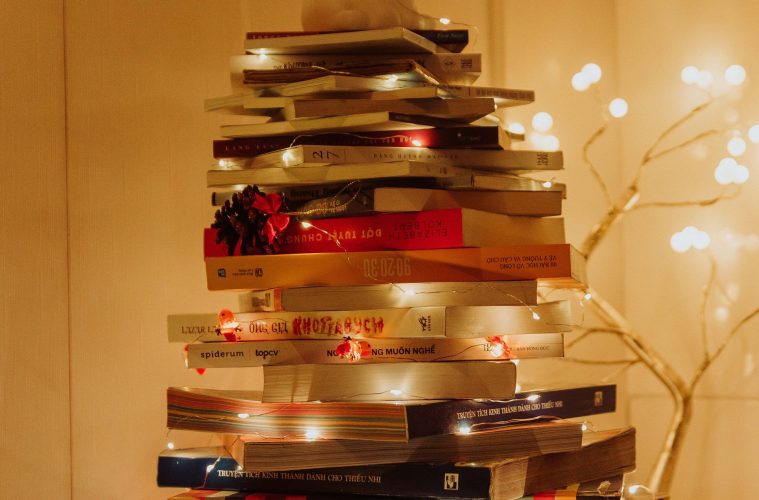
Forget perfectly horizontal piles. Stack books vertically into a slightly irregular tower, alternating between large and smaller volumes.
The key is knowing when to stop. A few books can look relaxed and collected; a precariously tall tower is better left to the fictional homes of people who don’t have pets, children or visitors.
A small tower beside a reading chair or in an unused corner can fill an awkward space without making it feel furnished for the sake of it.
Turn a beautiful cover into wall art
Some books have covers that deserve to be seen rather than hidden between two other spines. Use a picture ledge, plate stand or narrow shelf to display a favourite cover facing outwards.
This works particularly well with art, photography, gardening, fashion and travel books, but there’s no reason a novel with a beautiful vintage cover can’t get the same treatment.
The best part is that it can change. Swap the book when you fancy a different colour or mood, just as you would change a framed print.
Put books under a bench
The space underneath a bench is often treated as a place for shoes, baskets or absolutely nothing. A few neat stacks of books offer another option.
Arrange them horizontally beneath a hallway, bedroom or living-room bench, leaving enough breathing room around each pile. The result is practical if the books are ones you actually want to reach, while also making use of an otherwise overlooked area.
Give your bar cart a new job
A bar cart can become a miniature mobile library. Remove a few bottles and glasses and replace them with books, a plant, a candle and some small decorative objects.
A cart is particularly useful if you like changing things around. Move it beside a reading chair, into a bedroom or next to the sofa depending on where you’re spending time.
And if you actually use the cart for drinks, there’s no need to choose. Keep the bottom shelf for the bar and turn the top into a small book display.
Make a reading basket
Instead of having books scattered around the house, gather the ones you’re currently reading in a large basket beside your favourite chair.
Add a notebook, reading glasses or a small blanket and you have a reading corner that looks intentional without being overly styled. It also solves the very real problem of having several half-read books migrating from room to room.
Build a low-level library
Books don’t have to be displayed at eye level. A row of low stacks along the bottom of a wall can create a relaxed, informal library, particularly in a study, child’s bedroom or living room.
This approach is also useful if you have an awkward stretch of unused wall that isn’t deep enough for conventional shelving. Mix upright books with horizontal stacks to avoid making it look too uniform.
Let a staircase become a bookshelf
If your staircase has a wide landing, built-in shelving or an unused space underneath it, consider turning the area into a little library.
You don’t necessarily need to install expensive shelving. A few well-organised stacks can work in an open nook, provided they don’t interfere with the stairs or create a trip hazard.
It can be a particularly nice spot for books that relate to the room nearby: cookbooks close to the kitchen, children’s books near a play area or gardening titles near a door leading outside.
Put cookbooks where you actually use them
Cookbooks are often some of the most colourful books in a home, so hiding them away isn’t always necessary.
Keep a small selection on a kitchen shelf or a section of open shelving, with some standing upright and others stacked horizontally. A large cookbook can also act as a base for a bowl or decorative object.
Just keep books away from splashes, steam, direct heat and cooking surfaces. A beautiful cookbook doesn’t need to become a very expensive trivet.
Make a book bouquet
For something a little less expected, gather books with attractive covers and place them upright in a large basket or open container, allowing the covers and spines to overlap slightly.
Think of it as a bouquet made from books rather than flowers. Botanical, gardening, art and photography books work particularly well, especially when you mix different sizes and textures.
Pair books with something completely unrelated
One of the easiest ways to make a book display feel personal is to combine it with something that has nothing to do with reading.
Try a stack of books with a vintage camera, an unusual stone, a collection of shells, an old magnifying glass, a quirky figurine or something you brought home from a trip.
The contrast is what makes the arrangement interesting. Instead of looking like a collection that was bought in one go, it tells a little story about the person who lives there.
Use books to connect colours
Rather than arranging your books into a perfectly coordinated rainbow, look at the colours already in the room.
A book with a muted green cover can visually connect a plant to a cushion. A blue spine can echo a ceramic vase. A warm terracotta cover can pick up the colour of a rug or artwork.
You don’t need to match everything exactly. Sometimes a near-match is what makes the room feel more natural.
ALSO SEE: How to decorate your entryway without overcrowding it
Feature image: Pexels
