
 Jade Mcgee
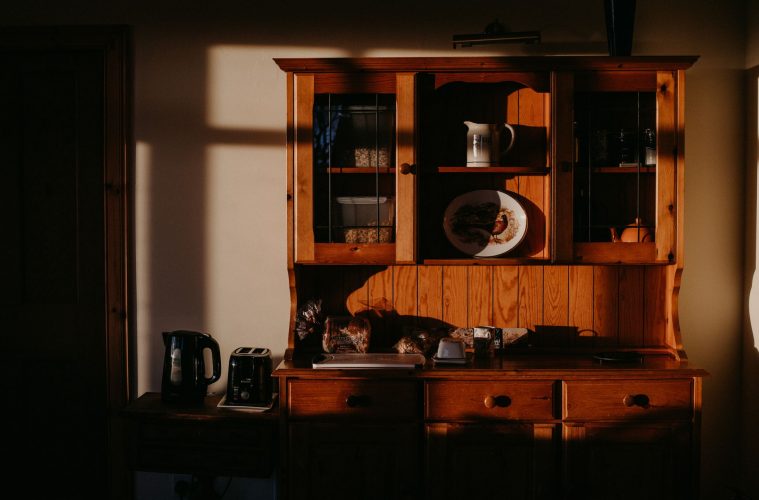
Hutches and kitchen dressers have returned to favour as part of a broader shift away from seamlessly built-in kitchens and toward spaces that feel accumulated rather than installed. The appetite for freestanding pieces that carry character, imperfection and visible history has given the hutch a renewed relevance it had largely lost during the decades when flush, handleless cabinetry defined the aspirational kitchen.
Understanding what a hutch actually does in a kitchen, and how to choose one that suits the specific context it will sit in, makes the difference between a piece that feels integral and one that looks like a storage solution that happened to be freestanding.
What a hutch brings to a kitchen
The functional argument for a kitchen hutch is storage: open shelving above for ceramics, glassware and displayed objects, closed or drawer storage below for items that do not need to be visible. But its design argument is more significant. A hutch breaks up the continuity of wall-to-wall built-in cabinetry, introducing a different material, tone, proportion and texture into what can otherwise become a visually undifferentiated kitchen. It does the work that open shelving does, in terms of visual relief and the opportunity for display, without requiring the permanent modification of existing cabinetry.
In practical terms, it is also one of the most rental-appropriate kitchen upgrades available: it requires no installation, no permission, no permanent change to the structure, and it can be moved. For this reason it is particularly valuable in kitchens that feel boxy, continuous or characterless and where permanent architectural intervention is not possible.
Choosing the right hutch for your kitchen
Scale is the first consideration. A hutch placed in a kitchen should feel proportionate to the room, which usually means going larger than instinct suggests: a piece that is too small for the wall it occupies looks tentative rather than deliberate. Height matters particularly, since a hutch that stops short of the ceiling in a kitchen with high ceilings can look unresolved, while one that reaches close to the ceiling creates a finished, built-in quality.
Antique and vintage pieces are the preferred choice for anyone who wants the imperfections and history that make a hutch feel genuinely collected rather than purchased. Original paint, worn edges, old hardware and the physical evidence of decades of use add the character that a new piece can only approximate. For kitchens with a country, farmhouse, coastal or traditional style, an aged piece in the right colour and scale is often more effective than anything newly made.
For contemporary kitchens, a painted or lacquered hutch in a bold standout colour can function as the one piece that introduces personality into a scheme that might otherwise read as overly restrained. A deep blue, warm terracotta or sage green hutch against more neutral cabinetry creates the focal point that a kitchen needs without requiring any structural change.
Styling principle 1: treat it as a bookshelf
The mistake most commonly made when filling a hutch is treating it as additional cabinet space, loading it with functional kitchenware and leaving gaps wherever things are in use. The approach that produces the best result is treating the hutch more like a carefully arranged bookshelf than a stocked kitchen cabinet. Each shelf should have both functional and decorative elements: a ceramic pitcher alongside a small framed artwork, a stack of cookbooks supporting a vintage jar, a serving bowl beside a ceramic vase. The mix of intentional kitchenware and purely decorative objects is what gives the display its sense of being accumulated over time rather than arranged in one session.
Styling principle 2: reserve it for special pieces
A hutch that holds the everyday dishes, the mugs that get used every morning, the bowls taken in and out at every meal, will almost always look unfinished and slightly depleted. The daily kitchenware belongs in closed storage where its constant in-and-out movement does not create visible gaps. The hutch works best as the home for pieces that are genuinely worth looking at: the inherited china, the heirloom crystal, the beautiful serving dishes brought out for gatherings, bar accessories, good linens. These items are often stored where they cannot be seen at all. The hutch is the opportunity to keep them visible every day rather than only on the occasions when they are used.
Styling principle 3: work with a loose colour palette
The display within a hutch reads most coherently when the objects share at least a loose colour relationship. This does not require precise matching: it means selecting pieces that sit in a consistent tone family, with a dominant colour and perhaps a second that appears as an accent. A hutch painted in a bold primary colour naturally curates itself towards objects that complement or contrast with it. An unpainted timber hutch requires a slightly more deliberate selection process, but the same logic applies. The imperfect, informal quality of the display, a little lopsided, not too symmetrical, with visible evidence of everyday life, is what makes a hutch feel inhabited rather than staged.
ALSO SEE:
Featured Image: Pexels
