
 Jade Mcgee
The most satisfying gardens have something happening in every month of the year. Not necessarily a spectacular display in every season, but something: a flush of flower, a shift in foliage colour, a fragrance that stops you in your tracks on a cool morning, or a structural form that catches the low winter light beautifully. Achieving this in a South African garden is less about following international planting guides and more about understanding which plants perform across multiple seasons in our specific climate.
The following selection mixes indigenous plants and well-adapted non-invasive ornamentals. Each one earns its place by offering interest in more than one season.
Plumbago auriculata
Plumbago is one of the most reliable multi-season performers in the South African garden. It flowers prolifically from spring through to autumn in sky blue or white, attracting butterflies throughout. In winter, when flowering slows, the evergreen foliage provides a fresh, clean backdrop for other plants. It is heat-tolerant, drought-resistant once established, grows quickly to fill a gap or cover a fence, and responds well to pruning if it begins to spread beyond its allotted space. Few plants in the South African garden offer as much for as little in the way of maintenance.
Camellia
Camellias are among the most valuable winter-flowering shrubs available to South African gardeners in cooler, higher-rainfall regions. Camellia sasanqua blooms from autumn through winter with a profusion of single or semi-double flowers in pink, white or red. Camellia japonica follows slightly later, into late winter and early spring, with larger, more formal double flowers. Both are evergreen, maintaining their glossy dark foliage year-round, and both produce their bloom display at precisely the time when the rest of the garden is quietest. They prefer slightly acidic, well-drained soil and some protection from the harshest afternoon sun.
Dietes grandiflora (large wild iris)
Dietes grandiflora is an indigenous plant that justifies its place in the four-season garden through sheer structural reliability. The arching fans of sword-like leaves provide year-round architectural interest, and the white iris flowers with their yellow and violet markings appear repeatedly from spring through summer whenever conditions are favourable. It is tough, drought-tolerant, evergreen and unfazed by the full range of South African conditions from frost to heat. It naturalises easily and forms impressive clumps over time that are easily divided to extend plantings elsewhere in the garden.
Halleria lucida (tree fuchsia)
Halleria lucida is an indigenous tree or large shrub that is deeply underused in South African gardens. It produces tubular orange-red flowers directly on its stems and branches, a habit that makes it exceptionally attractive to sunbirds year-round. Flowers appear at various times depending on the climate, but the plant is rarely without some bloom. The black berries that follow the flowers are an important food source for birds. It grows in full sun to partial shade, is relatively drought-tolerant once established, and has an attractive natural form that requires very little maintenance. As a four-season garden plant, it combines structural form, wildlife value and near-constant floral interest.
Miscanthus capensis (SA thatching reed)
Where ornamental grasses are concerned, Miscanthus capensis is the indigenous alternative to the invasive pampas grasses and exotic varieties that cause problems in South African landscapes. It forms an upright, arching clump of fine leaves that rustle beautifully in the breeze, and in late summer and autumn produces feathery silver-pink seed heads that are among the most elegant features in any garden at that time of year. The dried seed heads and winter-bleached stems carry interest well into the cooler months, when they catch the low light in a particularly appealing way. It is drought-tolerant, indigenous and entirely safe to grow.
Leucospermum (pincushion protea)
Leucospermums are among South Africa’s most spectacular flowering shrubs, producing their extraordinary pincushion flowerheads in shades from palest cream through yellow, orange and deep red. Most varieties flower from late winter through spring, which gives them a critical role in the garden calendar: they provide bold, dramatic colour at the time when many other shrubs are still dormant or bare. The evergreen foliage, often deeply textured and silvery-green, provides year-round structure. They prefer well-drained, acidic, nutrient-poor soils, minimal additional fertiliser and excellent air circulation — conditions that, once understood, make them straightforward to grow successfully.
Roses
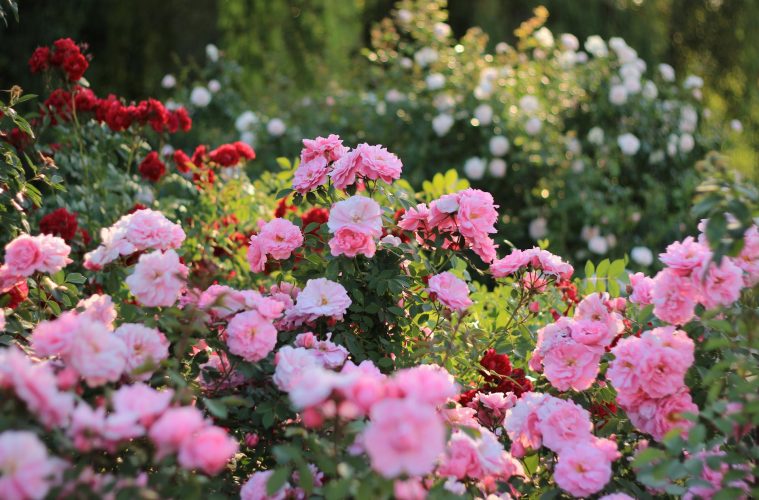
Properly chosen and cared-for roses are among the most rewarding multi-season plants in the South African garden. Modern shrub roses and the more disease-resistant hybrid teas produce their main flush in spring, repeat through summer and into autumn, and then offer a further seasonal contribution in the form of rosehips through winter. These orange, red and yellow seed pods are not only decorative but are an important food source for garden birds through the colder months. To encourage hip production, stop deadheading repeat-blooming roses by late autumn and allow them to set fruit. The combination of spring flowers, summer repeat bloom and winter hips makes roses genuine four-season plants when managed with this intention.
Hellebore (Lenten rose)
Hellebores are the quiet stars of the winter garden. They produce their nodding, cup-shaped flowers in late winter and early spring, in colours ranging from near-white through dusky pink, deep plum and slate green, at precisely the time when colour in the garden is most welcome. The tough, glossy evergreen foliage is attractive year-round, providing deep green ground-level interest under deciduous trees or in shaded areas where few other plants perform. They are slow to establish but extraordinarily long-lived once settled, spreading gradually to form a ground cover that suppresses weeds and requires almost no maintenance. They are non-invasive, deer-resistant and entirely reliable.
Cussonia spicata (common cabbage tree)
Cussonia spicata is one of South Africa’s most distinctive indigenous trees, with its dramatic spiralling leaf arrangement at the ends of thick, corky branches. It provides year-round structural interest that few other trees can match, and its architectural quality becomes most apparent in winter when the bold form of the branch structure is fully visible. The creamy flower spikes appear in summer and are heavily visited by insects and birds. The berries that follow are an important food source for wildlife. It is drought-tolerant, hardy across a wide range of South African climates, and grows well in both garden beds and large containers.
Virgilia oroboides (Cape lilac / keurboom)
The keurboom is a fast-growing indigenous tree that earns its place in the four-season garden primarily through its spectacular spring flowering display: masses of fragrant pink pea-flowers that cover the tree entirely and are irresistible to insects and birds. After flowering, the attractive grey-green compound foliage provides a light, airy canopy through summer and autumn. It is one of the fastest-growing indigenous trees available, reaching three to four metres within a few years, and while it is relatively short-lived by tree standards, its rapid establishment makes it invaluable for providing quick structure and shade in a new garden. It naturalises well in the fynbos transition zone and is entirely non-invasive.
ALSO SEE:
Featured Image: Pexels
