
 Jade Mcgee
There is something quietly mesmerising about a terrarium. A sealed glass world where ferns unfurl, moss thickens, and condensation rises and falls like its own private weather system. It feels part science experiment, part living sculpture.
The appeal is not just aesthetic. A well-built terrarium becomes a self-sustaining ecosystem, recycling its own moisture and requiring very little intervention once established. And despite how intricate they look, they are surprisingly simple to make.
Here is how to create one properly, from choosing the right container to caring for it long term.
What is a terrarium?
The word terrarium comes from the Latin terra, meaning earth, and refers to a glass container designed to grow plants in a controlled environment.
In a closed terrarium, moisture evaporates from the soil and leaves, condenses on the glass and falls back into the substrate. This continuous water cycle allows plants to thrive with minimal watering. Some sealed terrariums have reportedly survived for decades with almost no disturbance.
The key is balance. Too much water and the ecosystem moulds. Too little and it dries out. Build it correctly from the start, and nature largely takes over.
Choosing the right container
A clear glass vessel is essential. It can be as small as a jar or as large as an old fish tank, provided it allows light in and can be sealed.
For beginners, a medium-sized glass jar with a cork or glass lid works well. A wider base makes layering easier, while a narrower opening helps maintain humidity.
Avoid coloured or heavily textured glass, as clarity allows you to monitor condensation and plant health.
What you need before you begin
Terrariums require layering, much like a miniature landscape. Each layer serves a purpose, from drainage to filtration.
You will need:
- A drainage layer, such as fine gravel or small stones
- Activated charcoal to reduce odours and bacterial build-up
- A well-draining growing medium
- Moss or decorative top dressing
- Small plants suited to humidity
- Long tweezers or a narrow tool for positioning
The charcoal step is not strictly essential, but it significantly improves long-term success by helping prevent stagnation.
Selecting the right plants
Closed terrariums suit plants that enjoy humidity and indirect light. Choose small varieties that will not outgrow the space too quickly.
Good options include:
- Small ferns
- Peperomia
- Pilea
- Moss
- Fittonia
Avoid succulents and cacti in sealed terrariums. They prefer dry air and can rot in high humidity.
Scale is important. When finished, at least one-third of the container should remain visually open to allow room for growth.
How to build your terrarium step by step
1. Create the drainage layer
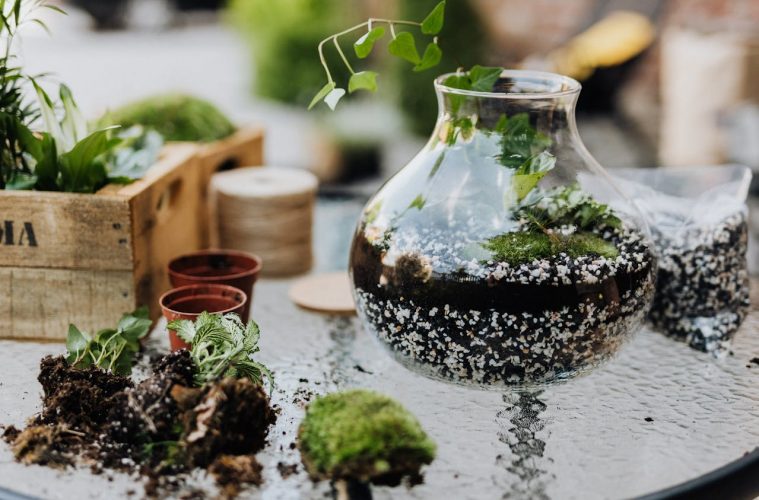
Add a layer of gravel or small stones to the bottom of the container, roughly 1–2 cm deep. This prevents plant roots from sitting directly in excess moisture.
Spread evenly using a spoon or long tool.
2. Add activated charcoal
Sprinkle a thin layer of activated charcoal over the stones. This helps absorb impurities and keeps the environment fresh.
3. Add the growing medium
Add 5–8 cm of well-draining potting mix. A blend of houseplant compost with a small amount of coco coir works well.
Gently level the surface without compacting it too firmly.
4. Position hardscape elements
If you are adding decorative stones or driftwood, place these first. They form the structure of the landscape and are easier to position before planting.
5. Plant carefully
Remove excess soil from plant roots before placing them in small holes in the substrate. Use tweezers or a narrow tool to position them neatly.
Firm the soil gently around each plant.
6. Add finishing touches
Top exposed soil with moss or fine gravel. This improves aesthetics and helps retain moisture.
7. Water lightly
Water sparingly. The soil should be damp but not wet. A spray bottle works well to avoid over-saturating.
Wipe the inside of the glass clean before sealing.
Where to place your terrarium
Position it in bright, indirect light. Direct sunlight can overheat the glass and scorch plants quickly.
For the first two weeks, leave the lid slightly ajar to allow excess moisture to escape. Once condensation settles into a light mist rather than heavy droplets, you can fully seal it.
How to care for a closed terrarium
Once balanced, maintenance is minimal.
If condensation builds excessively, open the lid for a few days.
If the soil appears dry and plants droop, add a small amount of water.
Trim yellowing leaves promptly to prevent mould.
In most cases, watering is needed only a few times a year.
The goal is equilibrium, not intervention.
Why terrariums are so addictive
Terrariums combine design, horticulture and observation in one compact form. Each one behaves slightly differently depending on light, plant choice and microclimate.
They are also endlessly customisable. Minimalist moss landscapes feel calming and sculptural, while layered fern compositions create miniature woodland scenes.
Once you build one successfully, the temptation to experiment again is strong.
The bottom line
Making a terrarium is less complicated than it looks. With the right layering, appropriate plants and careful watering, you can create a self-sustaining ecosystem that requires very little ongoing care.
It is gardening scaled down to its most captivating form.
ALSO SEE:
Featured Image: Pexels
