
 Jade Mcgee
Shaded areas are where many gardens quietly give up. The lawn thins, weeds move in, and the bed under the tree or along the north-facing fence becomes an embarrassment rather than a feature. But shade is not the obstacle it is often treated as. Matched to the right plants, it becomes a growing condition rather than a limitation.
Ground covers are particularly well-suited to shaded spaces. They spread to fill awkward gaps, suppress weeds by blocking light to the soil surface, reduce erosion on slopes and retain moisture in beds that dry out quickly. Here are some of the best performers for gardens with limited sun.
Wild ginger
Wild ginger is one of the most underused shade plants in the home garden. Its large, glossy, heart-shaped leaves form a dense carpet that looks lush and considered even in deep shade, and it spreads steadily via shallow rhizomes without becoming invasive. Because it is a woodland plant, it wants moist, well-draining soil rich in organic matter. Dividing established clumps in spring is the easiest way to increase coverage. It is worth noting that despite its name and faintly gingery scent, wild ginger is not edible and belongs to an entirely different plant family from the culinary variety.
Golden Japanese stonecrop
Most sedums are sun-lovers, which makes the golden Japanese stonecrop a welcome exception. This compact variety grows to around seven centimetres tall, forming a dense mat of bright golden-green succulent foliage that transitions to a deep reddish-purple in cooler months. It blooms in summer with small yellow flowers and is heat and drought-tolerant once established, though it prefers consistently moist soil. It is particularly well-suited to shady rock gardens, the edges of raised beds and the shaded corners of a patio.
Bunchberry
Bunchberry, also known as creeping dogwood, is a charming flowering ground cover for gardens with cool, consistently moist soil. It produces distinctive white four-petalled flowers in late spring to early summer, followed by clusters of small red berries that attract birds. The flowers do not appear until the plant is at least three years old, so bunchberry rewards patience. It spreads via underground rhizomes and forms a neat, medium-green carpet that stays attractive through most of the year. Avoid planting it in high-traffic areas where the rhizomes can be disturbed.
Partridge berry
For a wildlife-friendly ground cover that stays genuinely low, partridge berry is a fine choice. It grows to barely five centimetres tall and spreads to around thirty centimetres wide, producing small trumpet-shaped flowers in blush to white from spring through autumn and following them with vivid red berries that birds and small mammals find irresistible. It tolerates full shade and prefers acidic soil, which makes it an excellent underplanting for acid-loving shrubs like blueberries, azaleas and rhododendrons. It is generally unbothered by pests and diseases, making it one of the lower-maintenance options on this list.
Green and gold
Green and gold earns its name with a profusion of bright yellow daisy-like flowers that emerge in early spring above a mat of deep green foliage. It is a vigorous grower that spreads readily to fill shaded areas, tolerates partial to full shade, and is rarely troubled by pests or disease. It prefers consistently moist but well-drained soil and transplants easily, which makes it straightforward to use for filling gaps or extending coverage across a bed. It also performs well in containers, which is useful for gardeners who want the look of a naturalistic ground cover in a more controlled setting.
Woodland stonecrop
Where most sedums struggle without sun, woodland stonecrop is an exception that tolerates everything from full sun to full shade and handles moisture far better than its relatives. It forms a trailing, succulent mat of rounded leaves and produces small white flowers with pointed petals from late summer through to autumn. It creeps happily along rocks and into crevices, making it an excellent choice for retaining walls, steps and the edges of raised beds. Propagation is simple: cuttings can be taken at any point in the growing season, rooted in moist soil and used to extend coverage wherever it is needed.
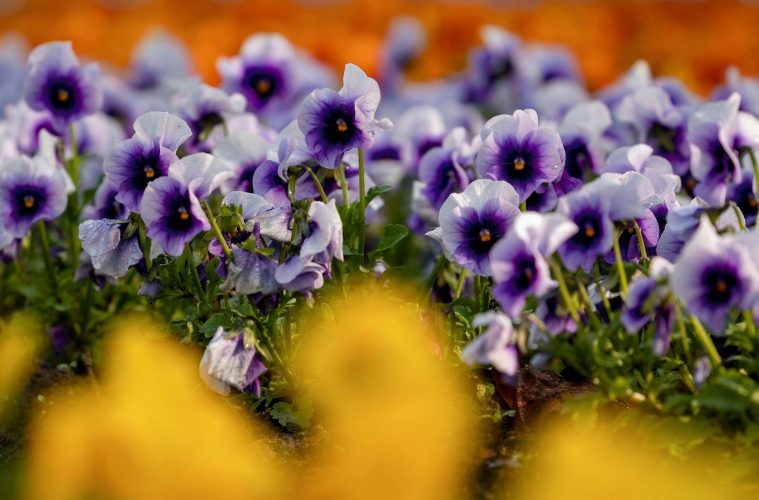
Pansies
Pansies are not often thought of as ground cover, but they do the job well in shaded beds, particularly during cooler months. They are cold-tolerant, low-growing when not in bloom, and come in a wide range of colours and flower forms. They reseed readily, which keeps them going from one season to the next with minimal intervention. Pinching back spent flowers encourages continued blooming. Their edible flowers are a practical bonus for anyone growing a kitchen garden. For shaded beds that need colour through the cooler months of the year, pansies are one of the most reliable and widely available options.
Bearberry
Bearberry is a hardy sub-shrub that works as both a ground cover and a trailing plant for walls. Its rounded, dark green, glossy leaves take on a bronzed purple tone in cooler months, giving it year-round visual interest. Small pink lantern-shaped flowers appear in late spring and are followed by small red berries that birds rely on for food. It spreads slowly via shallow rhizomes and dislikes being moved once established, so choosing the right location from the start is important. It is particularly well-suited to sandy, rocky or dry soils and slopes where other ground covers struggle to get purchase.
ALSO SEE:
Affordable ways to fill raised garden beds without buying bags of soil
Featured Image: Pexels
